AI · Live Events
EventBooker — Designing Conversational UX in the Age of AI
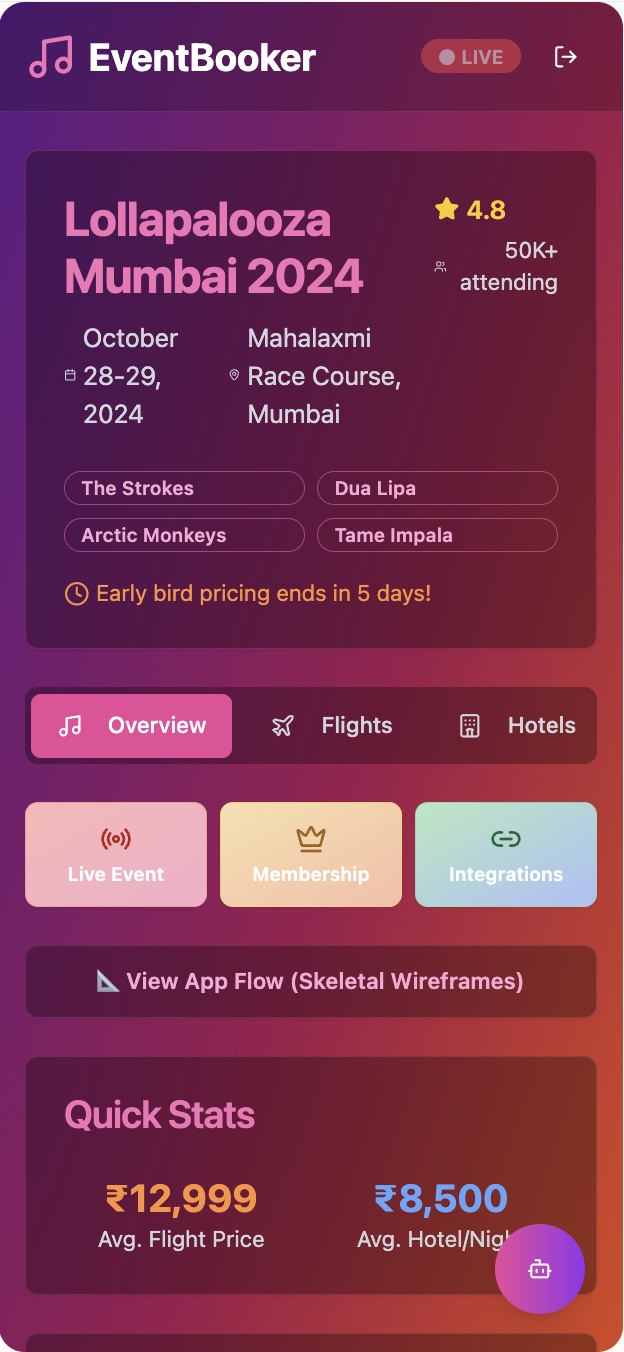
Planning an end-to-end trip around a live music event means juggling flights, hotels, merch, ticketing and fan communities across half a dozen disconnected apps. Fans lose context (PNRs in email, tickets in another app, hotel details in a browser tab), miss limited drops, and arrive stressed instead of hyped. There is an opportunity to unify the fan ecosystem into a single platform that amplifies event energy, simplifies planning, and unlocks new revenue streams for partners.
- Role
- UX Lead
- Duration
- Concept
- Company
- Concept project
- Domain
- Live Events · Consumer · AI Concierge
01
The problem
Planning an end-to-end trip around a live music event means juggling flights, hotels, merch, ticketing and fan communities across half a dozen disconnected apps. Fans lose context (PNRs in email, tickets in another app, hotel details in a browser tab), miss limited drops, and arrive stressed instead of hyped. There is an opportunity to unify the fan ecosystem into a single platform that amplifies event energy, simplifies planning, and unlocks new revenue streams for partners.
02
The approach
Design a unified fan ecosystem that takes a user from sign-in to the live event — booking travel, stay and apparel, joining the live stream and fan chat, unlocking membership perks and syncing with Spotify / YouTube / Weverse.
02.01
Opportunity spotting — identifying the market gap
Before sketching a single screen, I mapped where the fan economy was leaking value across five dimensions — cultural, behavioral, ecosystem, revenue and partner-side.
- Cultural shifts — the rise of the idol economy and fandom travel as a primary reason to fly.
- Behavioral patterns — group chats, merch drops and paid memberships as the connective tissue of fandom.
- Ecosystem gaps — no unified platform stitching travel, ticketing, merch and community together.
- Revenue blind spots — organizers leaving travel and membership leads on the table.
- Partner needs — travel and hotel platforms hungry for high-intent, event-driven traffic.
02.02
Personas — who EventBooker is for
Five archetypes anchor the design — two fan-side, three business-side — so every screen has a clear primary user and a clear secondary beneficiary.
- 🌸 Young Vibing Traveler — energetic, spontaneous, books on impulse with friends to chase the next festival.
- 💎 Premium Fan — stylish, loyal, splurges for VIP access, collects merch, lives for exclusive experiences.
- 🎤 Event Organizer — strategic and metrics-driven, manages large events and tracks fan engagement.
- ✈️ Travel Partner — marketer chasing high-intent leads during event season.
- 🎪 Event Ecosystem Manager — connector of sponsors, hotels, merch and fans, builds partnerships from day one.
02.03
Parent → inner screen flow
Mapped a Login → Event Home → {Flights · Hotels · Merch · AI Assistant · Live Event · Membership · Integrations} flow so every parent surface had a single clear job and every inner screen extended it without breaking context.
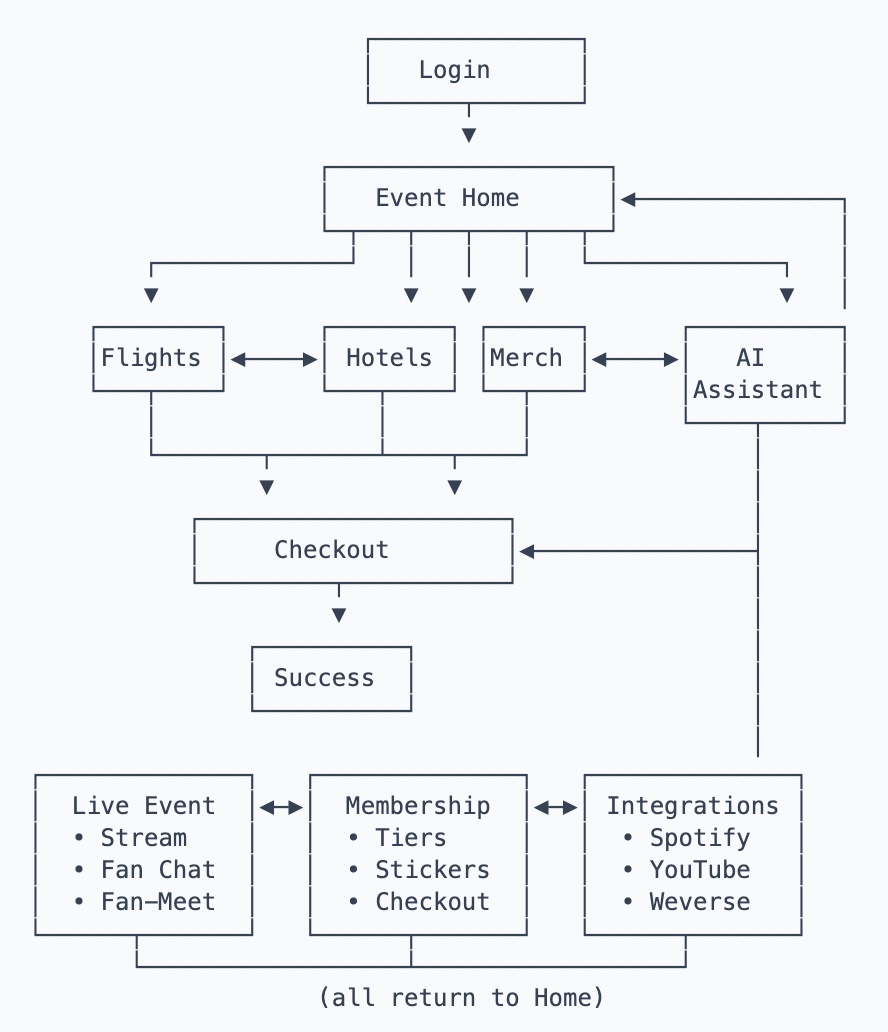
- Auth — social login via Google / Spotify / Apple.
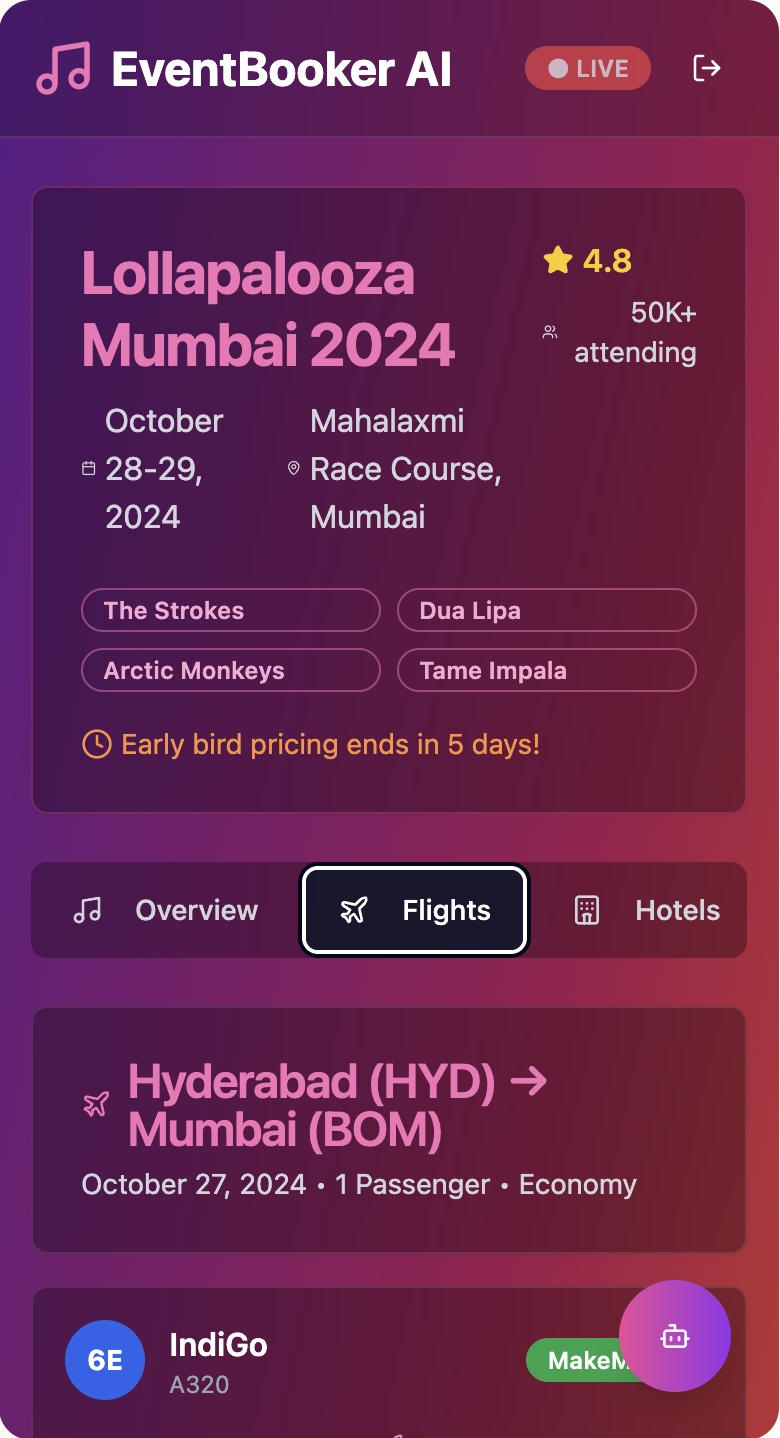
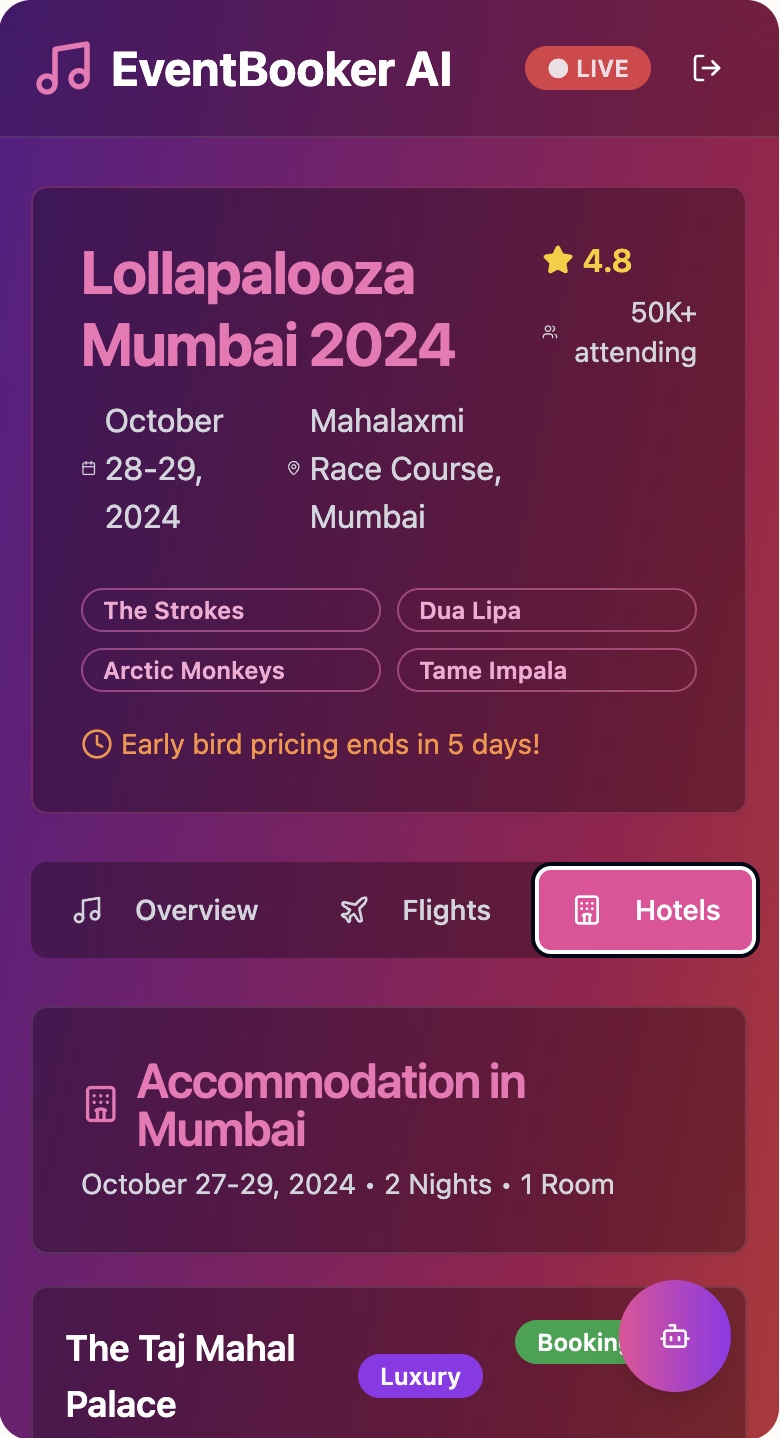
- Main — Lolla 2024 overview with quick nav across Flights, Hotels, Merch, Live, Membership.
- Booking — flights (Booking.com / MakeMyTrip), hotels near venue, merch & apparel, AI concierge for end-to-end planning.
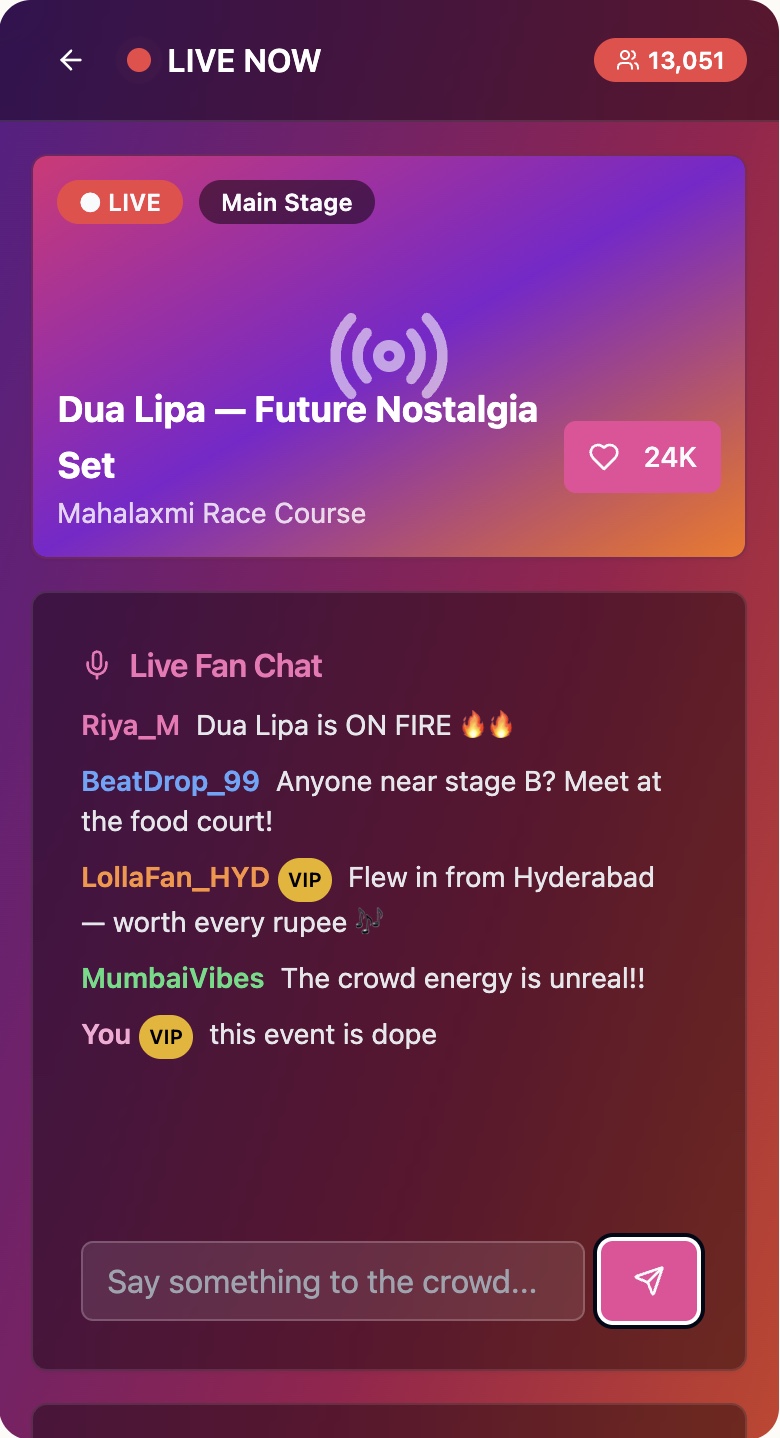
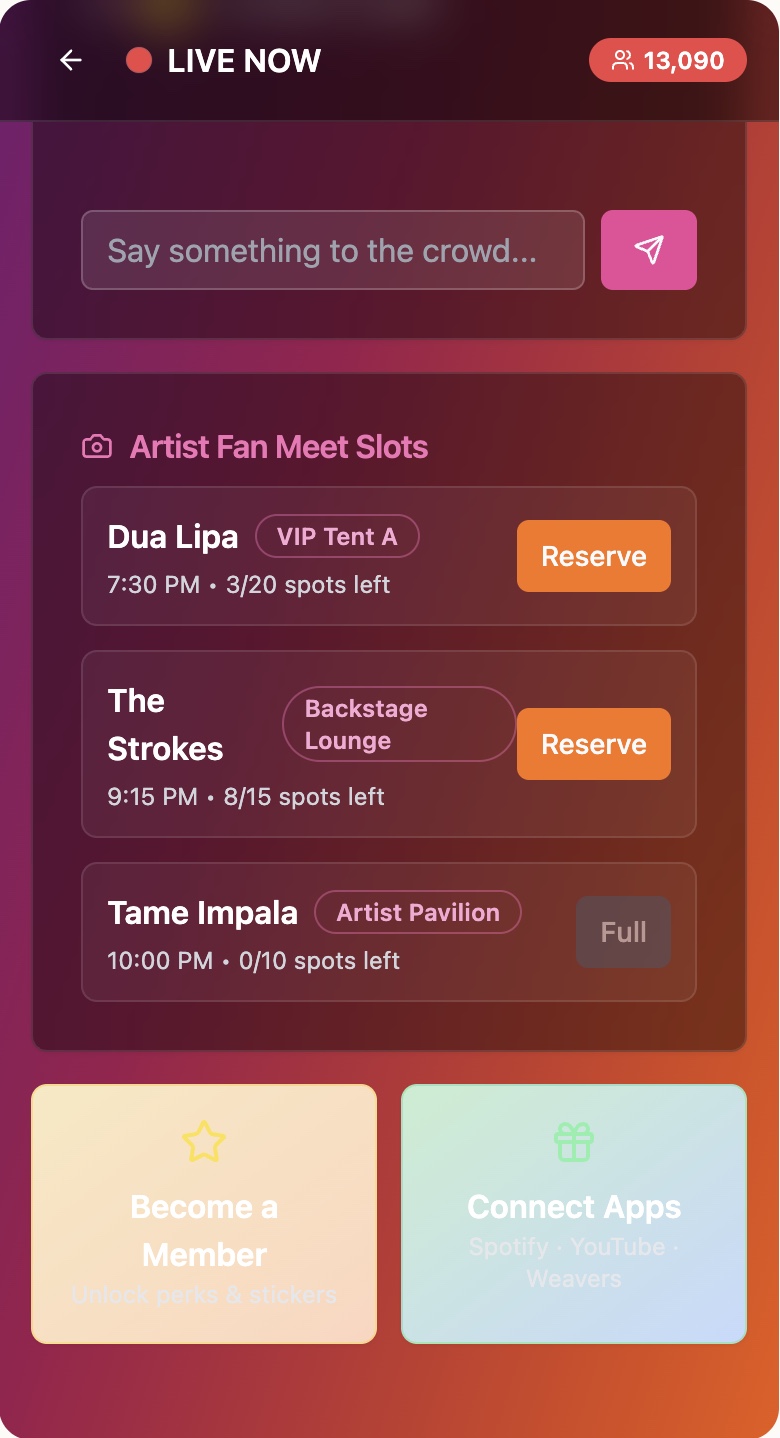
- Inner — live stream + fan chat + fan-meet slot, membership tiers with holo sticker collectibles, and Spotify / YouTube / Weverse account sync.
02.04
Frame-by-frame screen map
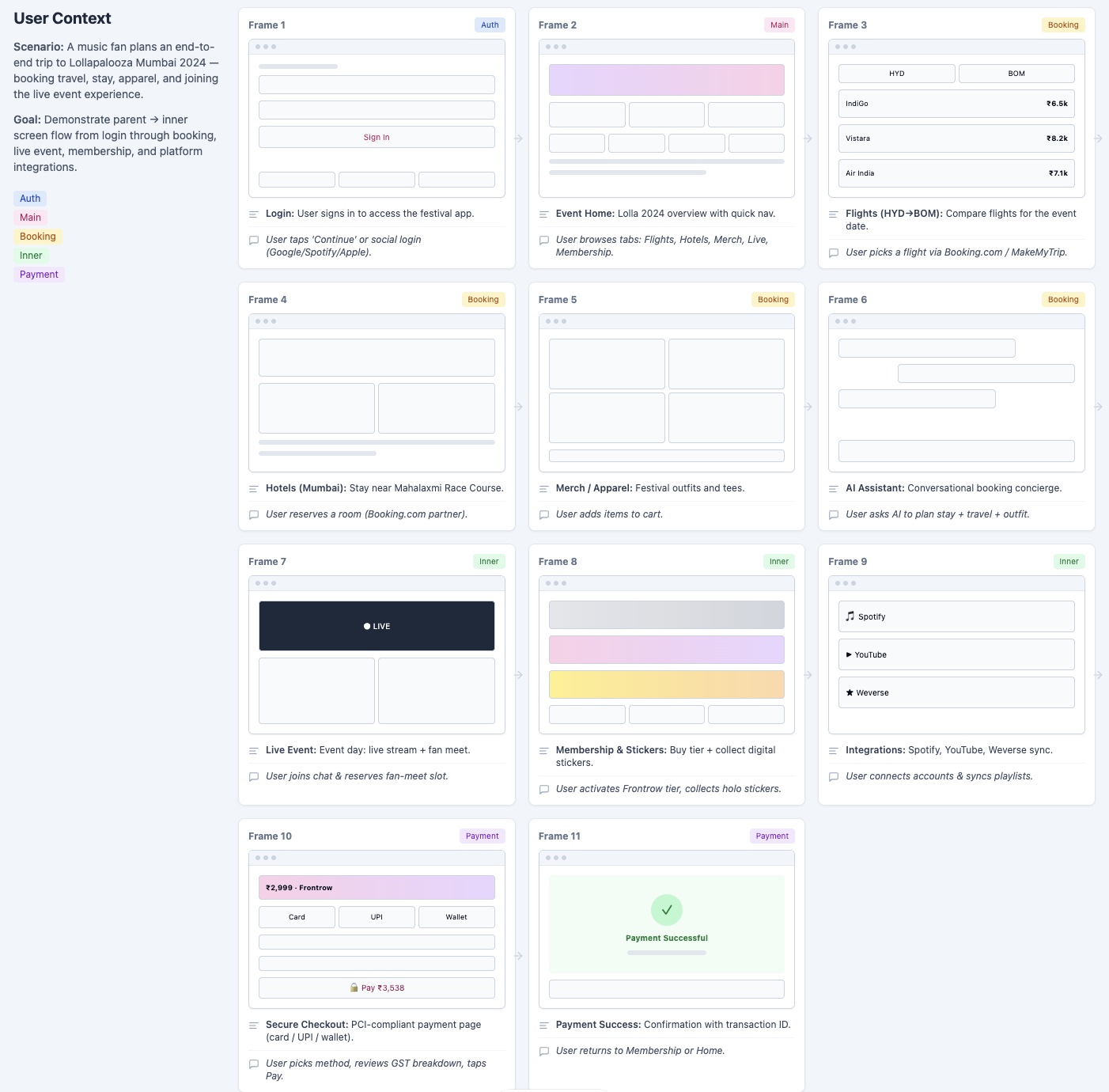
Eleven frames walk through the end-to-end Lollapalooza Mumbai 2024 journey — from auth to event home, booking, inner experiences and secure payment — color-coded by surface type.
02.05
Live event as the emotional peak
Event-day surfaces collapse to what matters: live stream, fan chat ranked by signal, and a fan-meet reservation slot — designed so the app gets out of the way during the show.
02.06
Designing the Conversational Layer
fans ask it to plan stay + travel + outfit, and it stitches together inventory from booking, merch and ticketing partners into one confirmable plan.
Scenario
Guardrail: Sensitive or Restricted Actions
- Scenario
- User tries to share payment details or asks the assistant to complete a financial transaction.
- Risk
- Security, compliance, and data‑handling boundaries.
- Designed assistant behaviour
- Detect sensitive information, stop the conversational flow, redirect user to secure UI, maintain calm, supportive tone.
- Response pattern
- I can help you compare and prepare your booking, but I can't take payment details here. You can complete the payment securely on the booking screen. Want me to open it for you?
- Outcome
- User stays safe, assistant stays predictable, and the flow continues without friction.
Scenario
Human‑in‑the‑Loop: Policy or Legal Ambiguity
- Scenario
- User asks about room‑sharing rules, hotel policies, or anything requiring human confirmation.
- Risk
- Incorrect guidance, liability, misinterpretation of partner policies.
- Designed assistant behaviour
- Avoid giving policy or legal advice, encourage direct contact with the hotel, provide the correct next step, maintain trust and clarity.
- Response pattern
- Room‑sharing rules vary by hotel, so it's best to confirm directly with the property. I can pull up the hotel's contact details if you'd like to check with them.
- Outcome
- Assistant stays helpful without overstepping, and users reach the right human authority.
Scenario
Fallback: Out‑of‑Scope or Risky Intent
- Scenario
- User asks about reselling tickets at a higher price.
- Risk
- Legal issues, platform misuse, unethical behavior.
- Designed assistant behaviour
- Recognize out‑of‑scope intent, decline without judgment, offer safe alternatives, keep the conversation moving.
- Response pattern
- I can't help with reselling tickets at a higher price, but I can help you explore options like cancellations, transfers, or adjusting your travel plans. What would you like to do next?
- Outcome
- A graceful refusal that maintains momentum and trust.
02.07
Design Process
A separate, detailed case study documents the full research and design process behind EventBooker — from problem framing and competitive audit to personas, journey mapping, information architecture and iterative testing.
Read the design process case study →03
The outcomes guiding project road map
Designing Connective Tissue — When a user journey spans multiple partner apps, APIs, and business models, the design challenge isn't to reinvent flights or hotels — it's to orchestrate the connective tissue. EventBooker's strength lies in how each surface (Flights, Hotels, Merch, Live, Membership) remains focused, while the AI concierge stitches them into a seamless, confidence-building experience.
Recommended Next Steps
- Conversational AI Style Guide — Establish a style guide for tone, fallback logic, and micro-interactions to ensure consistency across all conversational surfaces.
- Scenario Expansion — Gradually expand scenarios (e.g., cancellations, upgrades, loyalty rewards) to cover edge cases and maintain user confidence.
- User Testing — Validate flows with a representative set of fans to ensure the AI concierge and unified booking journey feel intuitive and trustworthy.
- Beta Rollout — Run controlled pilots with known fan groups to observe adoption, refine conversational flows, and stress-test integrations.
- Membership and collectibles work when they're earned during the experience, not sold before it.
- Emotional peaks drive action as much as feature lists do.
04
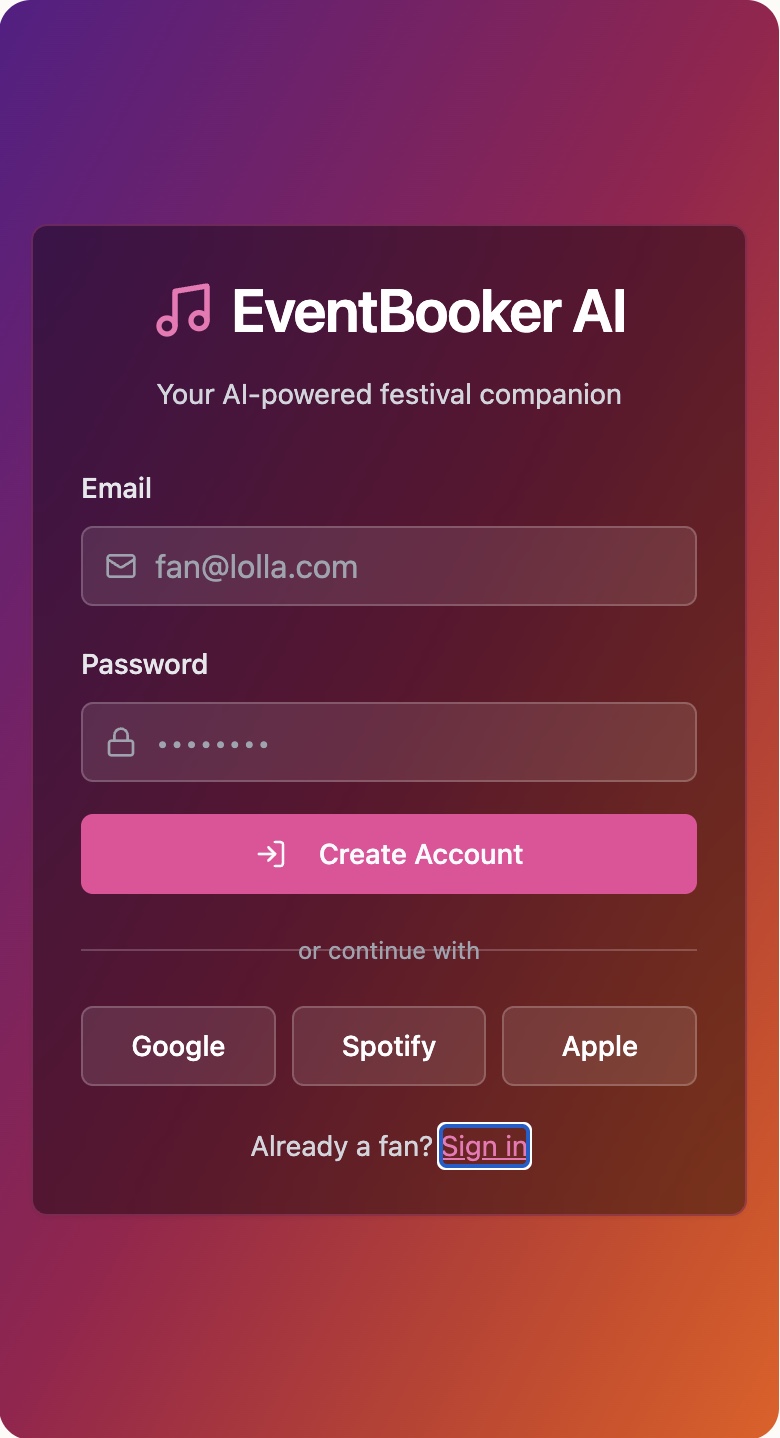
Selected screens
Keep reading
Other case studies
Working on a similar problem?
I take on senior contract, fractional and select full-time engagements where the brief is unclear and the stakes are real.
anjani.vc@gmail.com